
Pregnancy Yoga
TL;DR
Lamaze breathing is a structured, rhythmic breathing technique that helps reduce labor pain, improve oxygen flow, and keep mothers calm and in control during contractions.
Practicing breathing exercises during pregnancy trains your body to manage the pain–fear–tension cycle, making labor more manageable and less stressful.
There are four key Lamaze techniques: organizing breath, slow breathing, light accelerated breathing, and variable (hee-hee-hoo) breathing, each used at different stages of labor.
The second trimester is ideal to start, but breathing exercises and safe pranayama like Nadi Shodhana can be practiced throughout pregnancy with medical guidance.
Regular practice at home improves relaxation, sleep, and anxiety levels, while also preparing you for real labor situations.
Lamaze breathing supports both vaginal and C-section births by reducing anxiety, improving focus, and aiding recovery, making it a versatile tool for all delivery types.
If you are pregnant and someone has told you to "just breathe through it" during labor, they are actually right, but only if you know how. Breathing is not just something your body does automatically. The right breathing exercises for pregnancy can genuinely reduce pain, lower stress hormones, and keep you calm and in control when contractions hit.
In this guide, we cover everything from what Lamaze breathing actually is to safe pranayama you can practice at home today, all in simple, practical language.
What is Lamaze breathing, and how does it work?
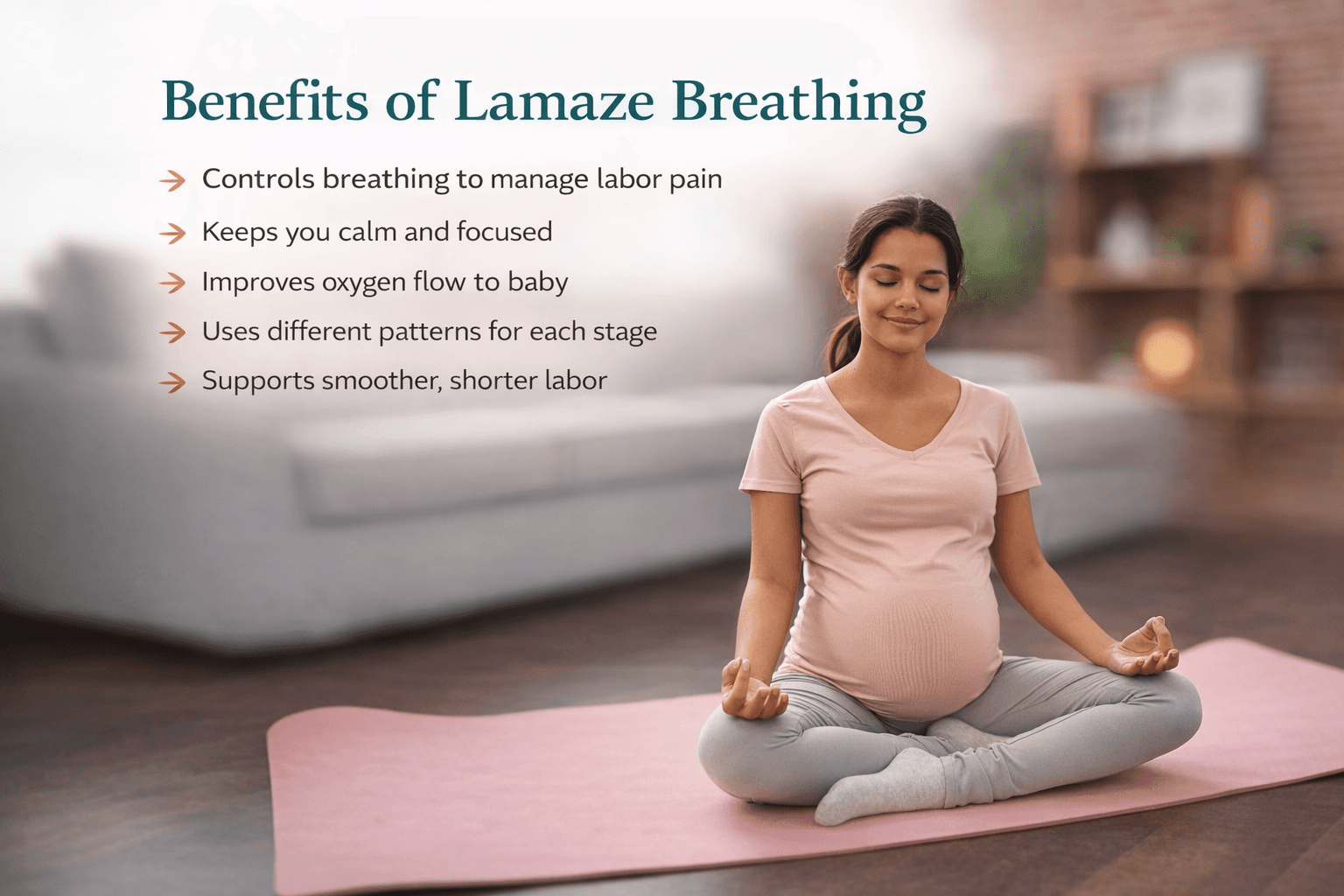
Lamaze breathing is a controlled, rhythmic breathing technique designed to help you stay calm and manage pain during labor. It works by redirecting your focus away from discomfort and increasing oxygen supply to you and your baby.
Lamaze was developed by French doctor Fernand Lamaze in the 1950s. The idea is simple: when you breathe slowly and deliberately, your nervous system shifts out of "panic mode" and into a calmer state. This lowers your perception of pain, not by removing it, but by making it feel more manageable.
Today, Lamaze breathing is not a single fixed pattern. It is a toolkit. You use different breath patterns depending on which stage of labor you are in. The common thread is this: every breath is intentional, every exhale is a release of tension.
A 2021 study published in the journal Medicine found that women who used Lamaze breathing during labor had shorter labors, were more likely to have a vaginal birth, and experienced less postpartum bleeding compared to those who did not use any breathing technique.
Does Lamaze breathing actually help with labor pain?
Yes. Controlled breathing does two things at once:
It oxygenates your body: Deep, regular breaths keep both you and your baby well-supplied with oxygen, which helps your uterus contract efficiently and reduces fatigue.
It interrupts the pain-fear-tension cycle: Fear tightens muscles. Tight muscles hurt more. Controlled breathing breaks that cycle before it spirals.
It will not make labor painless; no technique can promise that. But it gives you something to do during a contraction instead of bracing against it. Most mothers who practice breathing exercises for pregnancy beforehand report feeling significantly more in control during labor, regardless of whether they choose an epidural or not.
Pro tip:
You can practice breathing during pregnancy, not just in the delivery room. Your body needs to learn these patterns so they come naturally under pressure, just like any other skill.
When should I start practicing Lamaze breathing during pregnancy?
The second trimester is ideal, but there is no wrong time to start.
Trimester | What to Focus On |
1st Trimester | Simple diaphragmatic breathing (belly breathing) for 5 to 10 minutes daily. Excellent for reducing morning sickness nausea and early anxiety. |
2nd Trimester | Introduce slow-paced Lamaze breathing and basic pranayama. Build it into a daily habit for around 10 to 15 minutes. |
3rd Trimester | Add all Lamaze patterns, including light accelerated, and variable breathing. Practice with your partner or support person. |
Starting breathing exercises for pregnant women for stress relief early pays dividends well beyond labor. Many mothers at Rita's Pregnancy 101 report that daily breathing practices during the second trimester significantly reduced their anxiety levels, improved their sleep.
It also helped them stay grounded during stressful moments, from a difficult scan result to family pressure. The techniques that help you in everyday life are the same ones that will carry you through labor.
If you enjoy yoga, you will be happy to know that several forms of pranayama during pregnancy, safe breathing like Nadi Shodhana (alternate nostril breathing) and Ujjayi (ocean breath), align closely with Lamaze principles and are safe from the first trimester. Always confirm with your doctor or midwife before practicing yoga for a high-risk pregnancy.
The 4 core Lamaze breathing techniques for labor
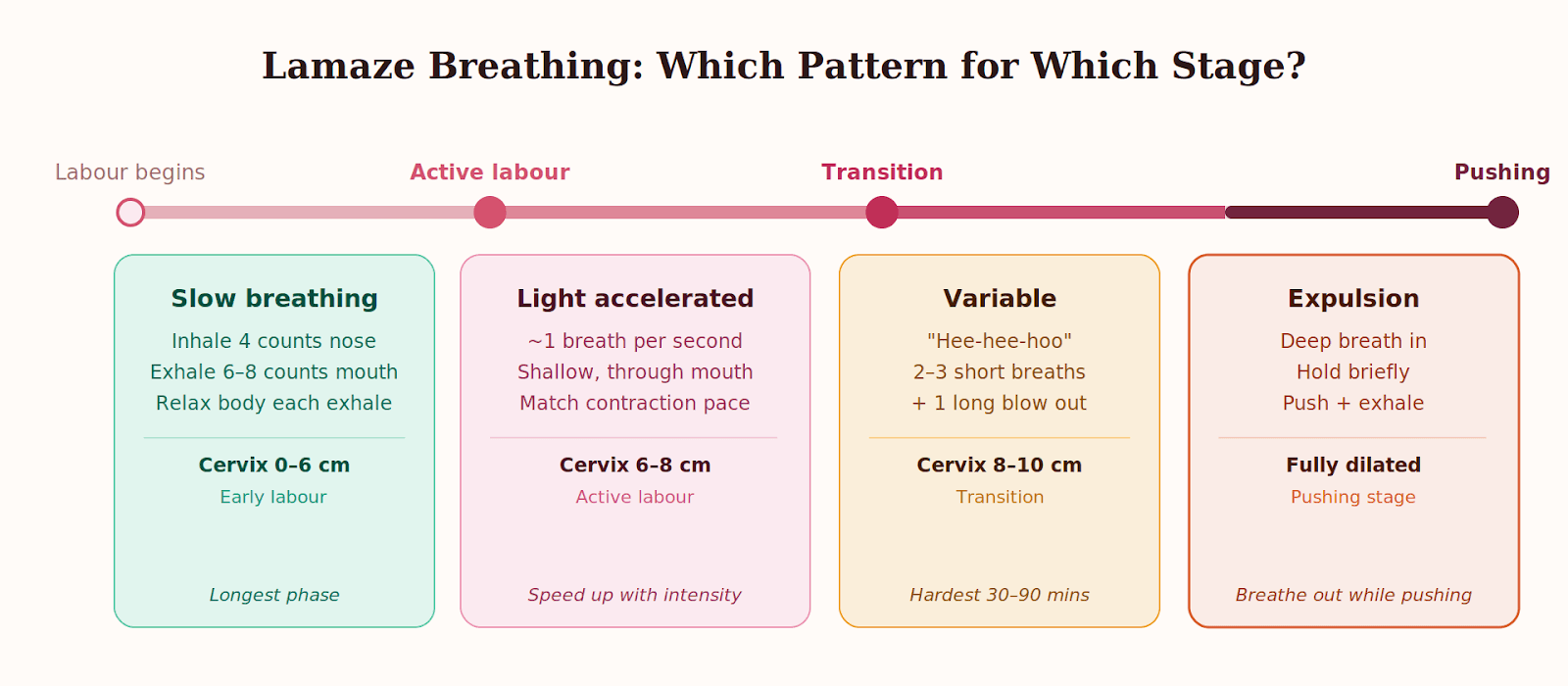
These are the four main patterns taught in Lamaze classes. Each is designed for a different stage of labor intensity. Learning all four as part of your breathing exercises for pregnancy practice means you are prepared for whatever comes.
1. Cleansing or organizing breath
Used at the start and end of every contraction.
Inhale deeply through the nose
Exhale fully with a long sigh through the mouth
Signals your body: a contraction is here, or it is over
Do this before switching to any other pattern
2. Slow breathing practice
Inhale through your nose for 4 counts
Pause briefly
Exhale through your mouth for 6 to 8 counts
With each exhale, consciously relax one body part, like the jaw, shoulders, hands, or lower back
3. Light accelerated breathing ( Active labor)
Breathe in and out through the mouth at about 1 breath per second
Keep breaths shallow and light
Speed up naturally as the contraction intensifies
Keep shoulders and jaw relaxed throughout
4. Variable or transition breathing
The familiar "hee-hee-hoo" pattern
2 to 3 short breaths in, one longer blow out
Also used to resist the urge to push before you are fully dilated
Fixes your focus and prevents panic at the hardest point of labor
Pro tip:
Always begin and end every contraction with an organizing breath, regardless of which pattern you are using in between.
Lamaze breathing techniques for normal delivery: What to actually expect
If your goal is a normal delivery with minimal intervention, consistent practice of Lamaze breathing techniques for normal delivery is one of the most evidence-based tools available to you.
Research shows that women who actively use these techniques are statistically more likely to avoid unnecessary C-sections and epidurals, not because breathing magically prevents complications, but because they remain calmer and more cooperative with the natural process of labor.
Here is the practical reality of breathing techniques for labor in a delivery room setting:
In early labor at home, slow breathing keeps your energy conserved and reduces anxiety.
As contractions become stronger and closer together, shifting to light, accelerated breathing helps you stay with them rather than tensing up against them.
During transition, often the hardest 30 to 90 minutes, the hee-hee-hoo pattern gives your mind something structured to hold onto.
During pushing, breathing out rather than holding your breath reduces the risk and maintains oxygen for your baby.
How do I practice breathing exercises during pregnancy at home?
Morning (5 minutes): Sit or lie comfortably. Place one hand on your belly, one on your chest. Inhale slowly through your nose; your belly should rise, your chest should barely move. Exhale through pursed lips. This is the foundation of all breathing exercises for pregnancy and is safe throughout all trimesters.
Midday (5 minutes): Close the right nostril with your thumb, inhale through the left. Close the left with your ring finger, exhale through the right. Repeat for 5 cycles. One of the safest pranayama practices for pregnancy, particularly good for third-trimester anxiety.
Evening (10 minutes): Choose an object or photo to focus on. Breathe in through your nose for 4 counts, out through your mouth for 6 to 8 counts. With each exhale, mentally release tension from one body part. Practice with your partner so they learn to coach you during labor.
How Rita’s Pregnancy 101 supports your pregnancy journey
If you want guided, structured practice rather than figuring it out alone, Rita's Pregnancy 101 Labor Preparation Sessions are designed exactly for this.
Step-by-step coaching of breathing patterns
When to switch between patterns during real labor
Combining breathing with movement like walking, birthing ball, and position changes
Pranayama practices are safe for each trimester
Over 5,000 Indian mothers have prepared for labor with Rita Mam and her certified team, entirely online, in the comfort of their homes.
Final words
Breathing exercises for pregnancy are not a replacement; they are a complement to it. Whether you choose an epidural, a natural birth, or anything in between, knowing how to breathe through pain and stress will make your experience calmer, more manageable, and more empowering.
Start simple. Five minutes of belly breathing every morning. If you want expert guidance from women who have helped thousands of Indian mothers through this exact journey, Rita's Pregnancy 101 is right here.
FAQs
How do you breathe during active labor?
Use light, fast breathing through your mouth (about one breath per second) as contractions build.
Start and end each contraction with a deep breath, and relax completely between them.
What is the difference between the Lamaze and Bradley methods?
Lamaze uses active breathing, movement, and coaching, while Bradley focuses on deep relaxation and inward focus. Lamaze is easier to learn quickly; Bradley needs more time and practice.
Can Lamaze breathing be used for a C-section birth?
Yes, Lamaze breathing helps reduce anxiety before surgery and keeps you calm during the procedure.
It also supports better recovery by helping manage pain and emotions.
What is an organizing breath in Lamaze?
An organizing breath is a slow, deep breath taken at the start of a contraction. It helps you prepare, relax, and signal the beginning and end of each contraction.