
pregnancy-yoga-class
TL;DR
Prenatal yoga can be safe and helpful during pregnancy, but only when it is gentle, pregnancy-specific, and approved by your doctor based on your individual health and risk factors.
Online prenatal yoga works well for many Indian moms if the class is truly prenatal, the instructor is trained, your home setup is safe, and you listen closely to your body.
Regular yoga classes are not ideal for most pregnant beginners because they may include deep twists, strong core work, inversions, breath holding, or backbends that are not pregnancy-safe.
Always ask your doctor clear questions before starting prenatal yoga, including what poses to avoid, warning signs to watch for, how often to practice, and any limits based on your medical history.
Key safety rules include breathing comfortably, moving slowly, avoiding pain or belly pressure, skipping deep backbends, twists, inversions, and belly-down poses, and stopping immediately if warning symptoms appear.
A good prenatal yoga program supports your changing body, reduces common pregnancy discomforts, prepares you for labor, and prioritizes safety over intensity or flexibility.
You're lying in bed and scrolling through Instagram at night, and an ad pops up for online prenatal yoga. Looks good, but then the questions start: Is this safe? Will it harm my baby? Should I ask my doctor first? If you've had these exact thoughts, don't worry about it; many expecting moms feel the same way.
Thousands of Indian moms-to-be want to stay active during pregnancy but aren't sure where to start, especially when it comes to online yoga classes for pregnant women. At Rita's Pregnancy 101, we understand this concern for Indian moms.
Between your mother-in-law's advice, family WhatsApp forwards, and random Google searches, getting clear information feels impossible. This blog breaks down everything you need to know about prenatal yoga safety in simple, straight talk.
Quick note: This blog is educational, not medical advice. Always follow your gynecologist’s guidance for your specific pregnancy.
Is yoga safe during pregnancy?
Yes, but it depends. For many people with a healthy, low-risk pregnancy, yoga can be safe during pregnancy, especially when it’s prenatal-focused, gentle, and taught with the right modifications. The goal of prenatal yoga is to support your changing body with mobility, stability, breathing, and relaxation.
That said, yoga safety in pregnancy depends on you, not just the activity. Your trimester, symptoms, medical history, and pregnancy risk factors all matter. If you’ve had bleeding, pain, placenta concerns, blood pressure issues, or cervical concerns, or you’ve been advised to limit activity, your doctor may recommend modifications or avoiding yoga for now.
Think of this section as the big picture: yoga is often safe when it’s the right type, the right intensity, and approved for your situation. Your doctor knows your body and pregnancy best. A 10-minute conversation can save you weeks of worry.
Can I take regular yoga classes when pregnant?
Sometimes. If you’re an experienced yoga practitioner, your doctor has cleared you, and the teacher is comfortable giving pregnancy modifications, you may be able to attend a regular class with changes.
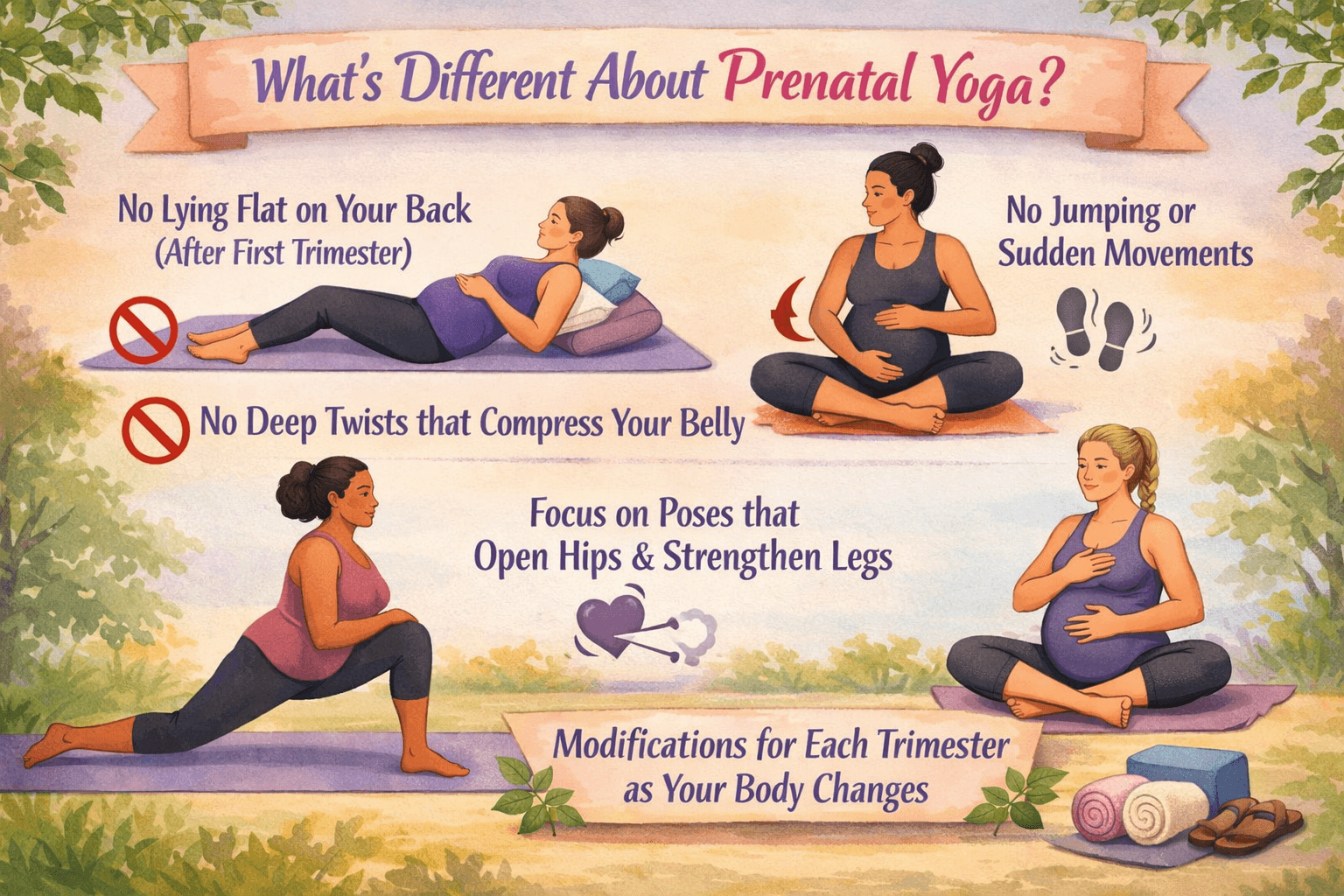
But for most pregnant beginners (and honestly, even for many experienced students), a general yoga class can include things that don’t match pregnancy needs, like deep twists, strong core compressions, long breath holds, heated rooms, fast transitions, and intense backbends.
If your main goal is to move safely and feel better, prenatal yoga is usually the safer option because it’s designed around pregnancy anatomy and common symptoms like pelvic pressure, back pain, breathlessness, and fatigue.
Still trying to figure out the right time to begin? Check out our detailed guide on when to start pregnancy yoga online to find your perfect timing.
Is online prenatal yoga safe during pregnancy?
Yes, but with the right approach. In-person classes aren't always practical. Maybe there's no good prenatal yoga studio near you. Maybe your schedule is busy. Maybe you're in your third trimester and just want to practice in your pajamas without judgment. All completely valid reasons.
Why can online classes be great?
No travel needed: Perfect when you’re tired or during the monsoon season.
Pause anytime: Need a bathroom break or some water? Just pause and continue later.
Practice on your schedule: Early morning or late night, choose what works for you.
Comfort of home: Your own space, your own temperature, and your bathroom close by.
Expert instructors: Learn from experienced prenatal yoga teachers from India or abroad.
The difference is simple. Online classes don’t give the instructor the same ability to physically adjust your alignment, and it’s easier for a beginner to copy a pose without noticing strain. That’s why understanding how to find the best pregnancy yoga classes matters, especially when practicing from home.
Online safety really comes down to three things for indian mom:
Right teacher and right class: Look for prenatal-specific yoga, not power yoga, weight-loss yoga, or hot yoga. The best pregnancy yoga classes are led by instructors trained in prenatal movement, who cue modifications clearly and encourage rest without pressure.
Right home setup: A safe practice needs enough space, a stable surface, and simple props for support. When you know the best pregnancy yoga classes, you will notice they guide you on setup so you are not wobbling, overstretching, or straining.
Right self-checking: Online prenatal yoga works best when you practice with body awareness. Comfortable breathing, slow transitions, and stopping at the first sign of discomfort are key signs that you are in the right class.
Rita’s Pregnancy 101 is built around these principles, offering expert-led sessions designed to help expecting mothers feel safe, steady, and supported while still gaining the benefits of movement, breathwork, and relaxation.
List of questions to ask the doctor before prenatal yoga
For an Indian mom, it's always better to ask and be clear. Your doctor would much rather answer your questions than have you guess or assume.
Question | Why it matters |
Is prenatal yoga safe for my pregnancy? | Every pregnancy is different, what is safe for someone else may not be safe for you. |
Are there any poses or movements I should avoid? | Certain poses may not be safe based on injuries or pregnancy-related conditions. |
What warning signs should I watch for during practice? | You need to know when to stop and when to contact your doctor. |
When can I start prenatal yoga? | Some people should wait, others can start earlier, your doctor can guide you. |
How many times a week should I practice? | Helps you find the right balance without overdoing it. |
What heart rate should I stay under during exercise? | Gives you a clear limit to exercise safely. |
Do I need special modifications based on my medical history? | Past surgeries or health issues can change what is safe for you. |
Are there positions I should avoid because of my condition? | Your specific health situation may require extra care. |
What symptoms mean I should stop immediately and call you? | Knowing the red flags helps you act quickly and protect your health. |
Prenatal yoga safety checklist for beginners
If you’re new, this prenatal yoga safety checklist will keep you grounded and confident, especially in online classes.
#1 Before you start prenatal yoga
Get clearance from your doctor (especially if you’ve had bleeding, pain, prior pregnancy complications, or you’ve been told to restrict activity).
Choose prenatal yoga, not regular yoga. Prenatal classes avoid common pregnancy no-go movements.
Pick the right time of day. Practice when you feel most steady.
Eat light. Avoid practicing on a totally empty stomach or right after a heavy meal.
Set up your space with a non-slip mat and a wall/chair nearby for balance.
Keep props ready, like a folded blanket and 2 pillows (these make prenatal yoga safer)
#2 During class (The real safety rules)
Breathing is your safety meter. If you can’t breathe smoothly through your nose or mouth, the intensity is too high.
No pain, no pressure. Avoid any pose that creates sharp pain, strong pelvic pressure, or a stretch that feels wrong.
Move slowly between positions. Pregnancy can increase dizziness, especially with quick up-down movement.
Stability over depth. Pregnancy hormones increase joint looseness, which can make overstretching easier.
Skip breath-holding. Gentle breathing is great; forceful holds are not.
Modify early, not late. If a pose feels “borderline,” adjust immediately.
#3 After class checklist
Hydrate and cool down. Give your body time to settle.
Notice the next few hours. Mild muscle tiredness can be normal. Sharp pain or heaviness is a sign to modify next time.
#4 Stop the session and seek medical advice if you notice
Vaginal bleeding or fluid leakage
Dizziness, faintness, chest pain, or severe headache
Shortness of breath that feels unusual
Calf pain/swelling, contractions that don’t settle with rest
Reduced fetal movement
Severe pelvic pain
What yoga poses to avoid during pregnancy?
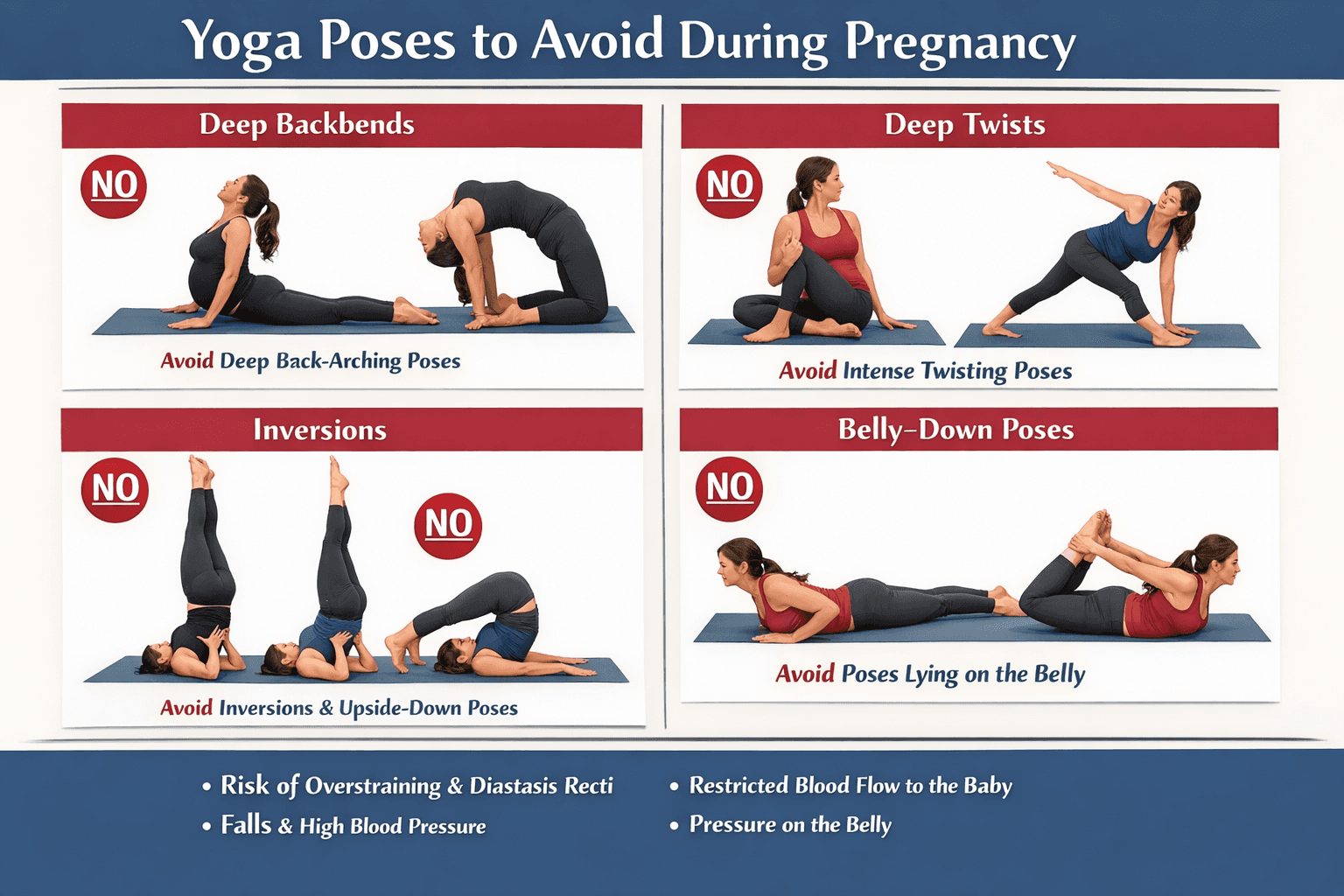
Deep backbends: Cobra pose (even in the first trimester), full wheel (chakrasana), camel pose (ustrasana), and any deep back-arching pose should be avoided because they overstretch the abdominal muscles, put pressure on the belly, increase the risk of diastasis recti, and compress internal organs.
Deep twists: Seated twists that close the torso, revolved triangle, and any twist that compresses the belly should be avoided because they can restrict blood flow to the baby, compress internal organs, and strain joints that are already loosened during pregnancy.
Inversions: Headstands (shirshasana), handstands, shoulder stands (sarvangasana), and plow pose should be avoided due to the high risk of falls from balance changes, sudden shifts in blood pressure, and unnecessary strain on the body during pregnancy.
Belly-down poses (no): Locust pose (shalabhasana), bow pose (dhanurasana), and any pose that requires lying on the stomach should be avoided because they place direct pressure on the belly.
Good quality online prenatal yoga programs are designed with pregnancy yoga safe poses in mind. They guide you through safe options for every stage, so you are never left wondering whether a pose is right for you or if you should be doing something else.
The bottom line
Prenatal yoga can be one of the best things you do for yourself during pregnancy. The back pain relief alone is worth it. The breathing techniques will help during labor. The quiet time to connect with your baby? It is priceless, right?
But it only works if you do it safely. Whether you're searching for online yoga classes for pregnant women near me or planning to practice from home, choose a proper prenatal program (not just any yoga with "modifications").
At Rita's Pregnancy 101, we believe every Indian mom deserves clear, honest information about pregnancy wellness. No judgment, no complicated medical jargon, just real talk about what works and what doesn't. Because your body is doing something incredible. Give it the gentle movement and care it deserves.
FAQs
What type of yoga is safe during pregnancy?
Prenatal yoga is usually the safest choice because it’s designed for the changes and common symptoms. Gentle, restorative styles with proper modifications can also be appropriate after doctor clearance.
Can you do the Cobra pose while pregnant in the first trimester?
It only does after your doctor has cleared you for exercise. Keep Cobra gentle and small, avoid forcing a deep backbend, and stop immediately if you feel belly pressure, pain, dizziness, or bleeding.
What do you need for pregnancy yoga?
You need a non-slip yoga mat, water, a pillow/cushion or folded blanket (for support), and a chair or wall nearby (for balance and safety).
Is yoga safe for high-risk pregnancy?
Not always. If your pregnancy is high-risk, do yoga only if your doctor says it’s safe. Many high-risk pregnancies need strict modifications or they may be advised to avoid yoga/exercise until it’s safe.