
Pregnancy Yoga
TL;DR
A high-risk pregnancy does not always mean complete bed rest. With your doctor’s approval and proper guidance, gentle prenatal yoga can still be practiced safely.
Yoga therapy can help reduce stress during high-risk pregnancy complications, which supports both the mother’s well-being and the baby’s health.
Prenatal yoga can be helpful for conditions like gestational diabetes because gentle movement improves blood sugar control and lowers stress levels.
Safe practices usually include gentle poses like Cat-Cow, Butterfly Pose, breathing exercises, meditation, and light walking with proper supervision.
Certain activities should always be avoided during high-risk pregnancy, such as hot yoga, intense breathwork, deep twists, inversions, and lying flat on the back after 28 weeks.
Practicing under expert guidance with trimester-based modifications helps ensure that yoga remains safe and supportive throughout a high-risk pregnancy.
If your doctor has told you your pregnancy is high-risk, your first instinct might be to stop all movement and rest completely. That is understandable. But here is what most of the Indian mothers misunderstood: stopping movement entirely is not always the safest choice.
Yoga for high-risk pregnancy, when done correctly with expert guidance, can actually support better outcomes for both you and your baby.
At Rita’s Pregnancy 101, Rita Ma'am and her team of certified instructors have guided 5,000+ Indian mothers through safe, modified prenatal yoga. This blog breaks down exactly what is possible, what is not, and how to know the difference.
Is prenatal yoga safe for high-risk pregnancy?
The answer depends on your specific diagnosis, your trimester, and whether you have your OB-GYN's clearance. "High-risk" does not mean no movement. It means modified, monitored movement. According to the PubMed central research, Yoga therapy (YT) can help reduce stress during high-risk pregnancy complications.
So, practicing YT in such cases can be a safe, practical, and cost-effective way to support overall well-being.
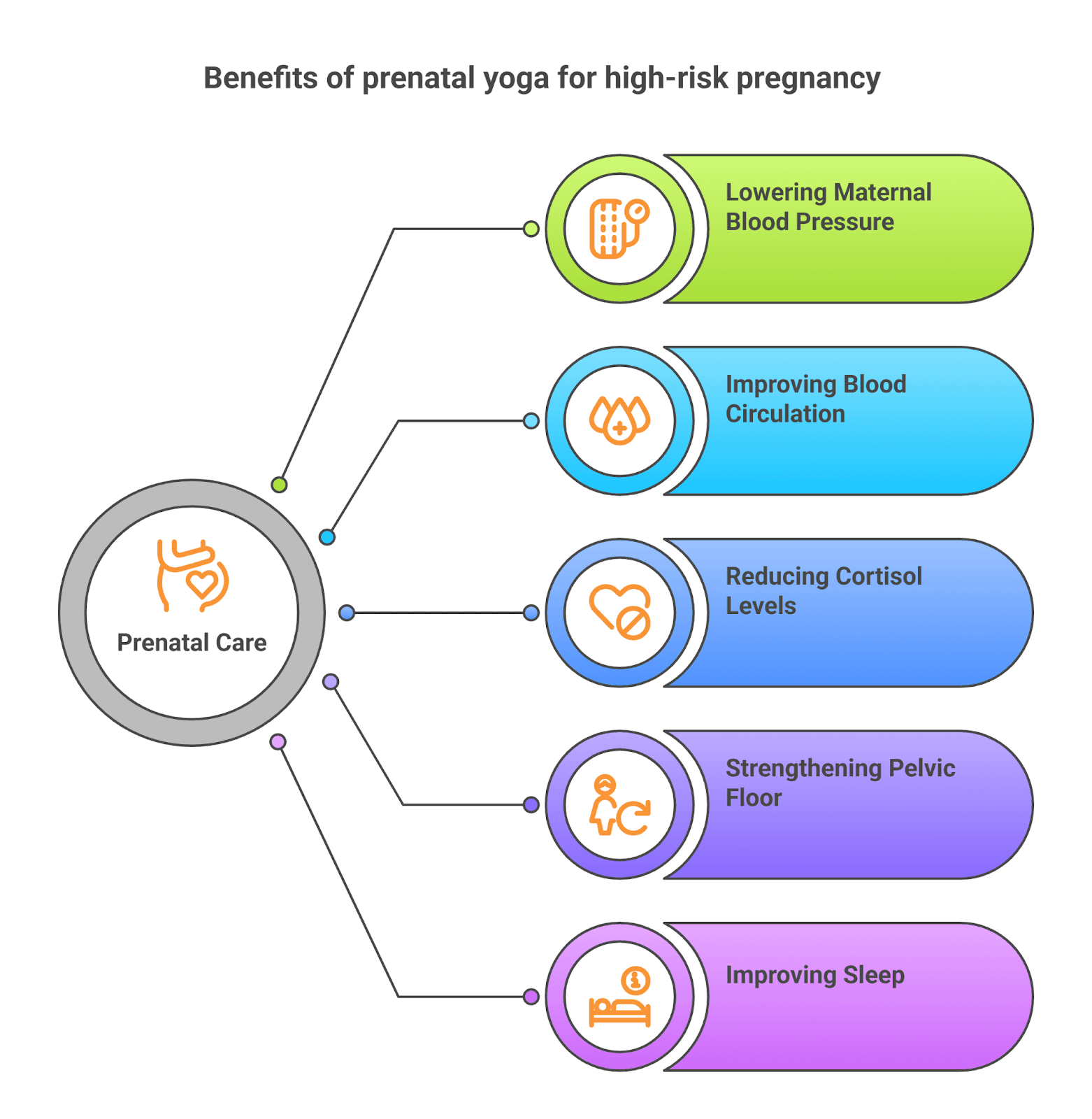
Benefits of prenatal yoga for high-risk pregnancy
Can I do prenatal yoga if I have gestational diabetes?
Yes and this is actually one of the most well-researched areas in prenatal yoga. Gestational diabetes (GDM) affects nearly 10 to 14% of pregnant women in India, making it one of the most common high-risk diagnoses Indian mothers face.
But, here is the good part that prenatal yoga for gestational diabetes is not just safe; it is actively recommended. Here is why yoga works for GDM. Physical activity helps your muscles use glucose more efficiently, which directly lowers blood sugar.
When you combine that with the stress-reduction benefits of prenatal yoga, you get a double impact, because chronic stress raises cortisol, which in turn raises blood sugar.
Prenatal yoga for Gestational Diabetes: Safe exercises to practice
Cat-Cow: Gently improves spinal circulation, reduces back pain, and keeps you active without raising heart rate.
Butterfly Pose: Opens the hips, improves pelvic blood flow, and is completely safe even in the third trimester.
Legs-Up-The-Wall: Reduces swelling in the feet and ankles (very common with GDM), improves venous return, and is deeply calming.
Seated Side Stretches: It stretches the sides of the body, strengthens the uterus, and eases the constipation that often comes with gestational diabetes.
Ujjayi Pranayama: Regulates the nervous system, reduces stress-driven glucose spikes, and can be practiced in any position.
What to avoid with GDM:
Hot yoga: It raises core body temperature, which is dangerous for the baby
Intense breathwork like Kapalabhati: It stimulates the stress response and is contraindicated in pregnancy
Any pose requiring you to lie flat on your back after 28 weeks
One practical tip:
Practice yoga at the same time each day, ideally for 30 to 60 minutes after a meal.This is when blood sugar levels are highest, and gentle movement helps bring them down naturally.
What exercises are safe for a high-risk pregnancy?
This is where most Indian mothers get confused because the answer is not the same for every high-risk condition. Here is a clear, condition-wise breakdown with pregnancy yoga precautions you need to know. This can be understood with the framework.
The Green-yellow-red framework
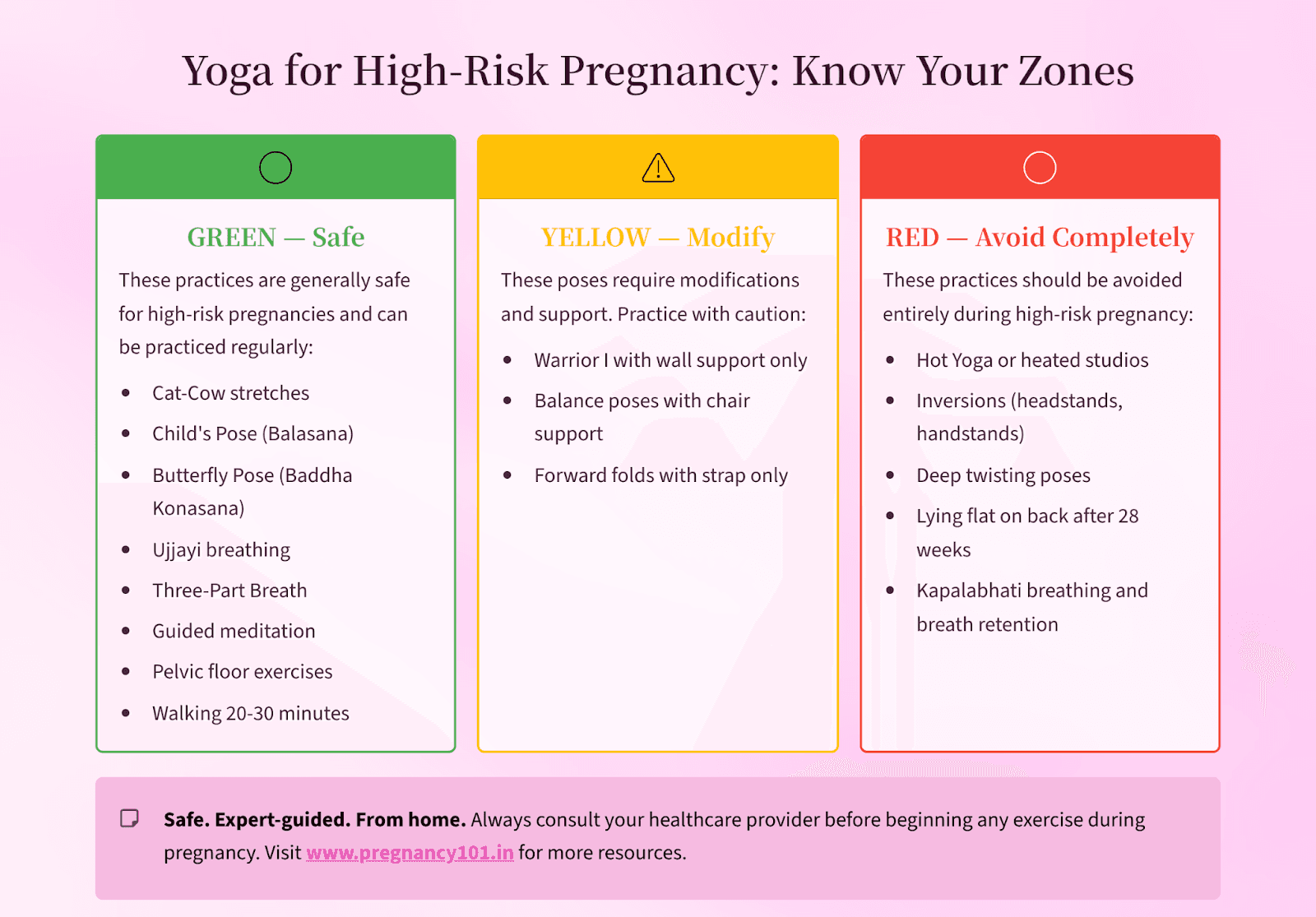
#1 Green (Safe for most high-risk pregnancies)
These are gentle, supported practices that the majority of high-risk mothers can do with a doctor's clearance:
Cat-Cow, Child's Pose, Butterfly Pose
Seated breathing practices like Ujjayi, Three-Part Breath
Guided meditation and Garbha Sanskar practices
Pelvic floor exercises (Kegels in yoga form)
Walking for 20 to 30 minutes at a comfortable pace
#2 Yellow (Safe with modifications)
These need props, reduced range of motion, or a certified instructor to supervise:
Warrior I with wall support, never free-standing in the third trimester
Standing balance poses always with a chair for support
Seated forward folds, which use a strap, never force the stretch
#3 Red (Avoid completely in high-risk pregnancy)
No matter how experienced you are, these are off the table:
In hot yoga or bikram yoga, core temperature rise is dangerous for fetal development
Inversions (headstand, handstand, shoulder stand), fall risk, and blood pressure impact
Deep belly twists that compress the uterus and restrict blood flow
Lying flat on your back after 28 weeks. It compresses the vena cava, reducing blood to the baby
Kapalabhati, Bhastrika, or any breath retention
Meet the P101 complete care prenatal classes from Rita’s pregnancy 101
If you are the kind of person who works better with a routine and live guidance, then the P101 complete care prenatal classes are designed exactly for you. Here is what your week looks like inside the programme:
3 exercise and yoga sessions covering prenatal movements tailored to your current trimester, not a generic sequence.
1 guided meditation session to reduce stress, improve sleep, and build that bond with your baby.
1 trimester information session covering fetal development, nutrition, common issues.
Every session is built around what your body is actually going through that week. For high-risk mothers, this matters more than it does for anyone else because your body is dealing with more. The program includes:
Home remedies for the everyday discomforts nobody talks about; nausea at 9 am before a work call, back pain after sitting at a desk all day, and sleeplessness at 2 am when your mind will not stop.
Trimester-specific nutrition guidance so you are not just eating "healthy" but eating right for your specific condition.
Continuous online support, not just inside class hours.
Labor preparation guidance is built into the sessions from the second trimester onward, so when the time comes, you are not panicking; you are ready.
The exclusive Monthly Miracle book set, developed from 15 years of Rita Ma'am's experience with expecting mothers across India.
Who is this for?
This program is ideal for working Indian mothers who cannot afford to piece together information from five different sources, like a yoga class here, a nutrition video there, and WhatsApp group for doubts somewhere else. The complete care program puts everything in one place, five days a week, with real people guiding you live.
For high-risk pregnancies specifically, the structure is the safety net. You are not guessing what to do on any given day. Your instructor knows your condition, your trimester, and your energy levels and adjusts accordingly. Your condition is specific. Your program should be too.
Join P101 Complete Care Prenatal Classes
Final words
The biggest myth about yoga for high-risk pregnancy is that you must choose between safety and staying active. You do not have to. With the right guidance, the right modifications, and a certified instructor who understands your specific condition, prenatal yoga becomes one of the most powerful tools in your high-risk pregnancy.
Stop guessing. Stop following generic YouTube videos designed for normal pregnancies. Get a practice built around you, your condition, your trimester, your baby.
Rita’s Pregnancy 101 is here for exactly that. Join 5,000+ Indian mothers who practice safely with Pregnancy101.
FAQs
What breathing exercises are safe during a high-risk pregnancy?
Ujjayi Pranayama and Three-Part Breath are safe for almost all high-risk pregnancies. These regulate the nervous system and improve oxygen delivery to the baby without raising blood pressure.
What counts as a high-risk pregnancy?
It counts when maternal or fetal conditions increase the chance of complications. Common causes include gestational diabetes, preeclampsia, placenta previa, IUGR, twin or multiple pregnancies, IVF conception, prior preterm birth, and thyroid disorders.
Is Yoga Safe During Placenta Previa Pregnancy?
Yes, yoga for placenta previa pregnancy is safe with medical clearance and strict modification. Breathing practices, light movement, and guided meditation are safe alternatives.
When Can I Start Yoga After IVF Pregnancy?
Most fertility specialists recommend waiting until 10 to 12 weeks to begin any structured yoga after IVF. Start only with gentle breathing and seated meditation in the first trimester.